
A child, a piece of paper, and a pencil. That is all you need for the games in this guide. No board, no dice, no cards, no app, no batteries, no pieces to lose down the back of the sofa. Paper games for kids no supplies are the oldest games in the world, and they are still the most useful: they work in a car, a waiting room, a classroom, a restaurant, or a rainy afternoon at home, and they cost nothing.
This guide has twenty of them, with full rules for each one. Some are classics your grandparents played. Some are word games that quietly teach spelling. Some are drawing games that make the whole table laugh. All of them need nothing but paper and a pencil, and all of them work for ages four to twelve. Keep a small notebook and a pencil in your bag, and you will never be stuck for something to play again.
What Counts as a Paper Game
A paper game is a game you can play with a sheet of paper and something to write with. Nothing else. If a game needs dice, it is not a paper game. If it needs cards, counters, or a board, it is not a paper game. The rule is strict, and the strictness is the point: when the only supplies are paper and a pencil, the game can be played anywhere, by anyone, at any time.
Paper games are also the fairest games. There is nothing to buy, so every child can play. There is nothing to break, so nothing goes wrong. And there is a record: at the end of the game, the paper shows what happened. Children keep their drawings, their word lists, and their scores. A paper game leaves something behind, and that is part of its charm.
The games below are grouped by type. The classics are the ones to learn first. The word games teach spelling without feeling like lessons. The drawing games are for laughing. The strategy games are for older children who want a real challenge. Start with the classics, and work your way through the list.
20 Paper Games for Kids
Here are twenty games, each with full rules. Every game lists the ages it suits and how long it takes, so you can pick the right one in seconds.
The Classics

1. Tic-Tac-Toe. Draw a three-by-three grid. One player is crosses, one is noughts. Take turns placing your mark in a square. The first to get three in a row wins. It is the first game most children learn, and it is the game that teaches them that a grid, a pencil, and an opponent are all you need. Best for ages 4 and up, five minutes.
2. Hangman. One player thinks of a word and draws a dash for each letter. The other guesses letters, one at a time. A correct letter fills in the dashes. A wrong letter adds a part to the hanging man: head, body, arms, legs. Guess the word before the man is complete, or lose. Use spelling words from school, and the game teaches as it entertains. Best for ages 6 and up, ten minutes.
3. Dots and Boxes. Draw a grid of dots, five by five. Players take turns drawing a line between two dots. When a player completes a box, they write their initial in it and go again. The player with the most boxes wins. It is quiet, strategic, and surprisingly tense. Best for ages 6 and up, fifteen minutes.
4. Battleships. Each player draws two ten-by-ten grids on paper: one for their own ships, one for tracking shots. Place five ships on your grid, then take turns calling out coordinates like “B7”. A hit is marked with a cross, a miss with a dot. Sink all five ships to win. It needs two sheets of paper and two pencils, and nothing else. Best for ages 7 and up, twenty minutes.
5. The Drawing Game. One player draws a picture in sixty seconds, and the other has to guess what it is. Then swap. Keep score across ten rounds. The worse the drawing, the funnier the game. Best for ages 5 and up, fifteen minutes.
6. Paper Fortune Teller. Fold a square of paper into a fortune teller: four corners, eight flaps, numbers and fortunes inside. One player picks a number, the other opens and closes the teller that many times, and the fortune is revealed. It is a craft and a game in one, and children love making their own. Best for ages 6 and up, fifteen minutes.
Word Games
7. Word Search Race. Each player writes a list of ten words, then hides them in a letter grid for the other to find. The first to find all ten wins. Making the puzzle is half the game, and it teaches spelling without a worksheet. Best for ages 8 and up, twenty minutes.
8. Hangman Variations. Play hangman with a theme: animals only, foods only, or words from a book the class is reading. Themed hangman turns a guessing game into a vocabulary game. Best for ages 6 and up, ten minutes.
9. Word Chain. Write a word, like “cat”. The next player writes a word starting with the last letter: “tiger”. Then “rabbit”, then “turtle”. Anyone who pauses for more than ten seconds is out. It is a vocabulary game that needs nothing but a pencil. Best for ages 7 and up, ten minutes.
10. The Alphabet Game. Pick a topic, like animals or food. Players take turns writing one thing starting with A, then B, then C. The game ends at Z, or when someone cannot think of a word. It is harder than it sounds once you reach Q, X, and Z. Best for ages 7 and up, ten minutes.
11. Categories. Pick a category, like countries or animals. Players take turns writing one thing in that category. No repeats allowed. The last player who can think of one wins. It is a memory and vocabulary game in one. Best for ages 7 and up, ten minutes.
12. Word Ladders. Write a word at the top of the page and a different word at the bottom. Change one letter at a time to turn the first word into the second, making a real word at each step. CAT to DOG takes four steps: CAT, COT, DOT, DOG. It is a puzzle game that teaches spelling and thinking. Best for ages 8 and up, fifteen minutes.
Drawing Games
13. Draw It Blind. Players close their eyes and draw a house, a cat, or a bicycle. Then they open their eyes and compare drawings. The worst drawing wins. It works because nobody can draw well with their eyes shut, so nobody feels judged. Best for ages 5 and up, ten minutes.
14. The Doodle Game. One player draws three random lines on the paper. The other has to turn them into a picture. A squiggle becomes a snake, a circle becomes a sun, a cross becomes a kite. It is an imagination game, and the results are always surprising. Best for ages 5 and up, ten minutes.
15. Complete the Picture. One player draws half a picture: half a house, half a face, half a car. The other completes it. Then swap. It teaches observation and symmetry, and it is much harder than it sounds. Best for ages 6 and up, ten minutes.
16. The Map Game. One player draws a treasure map on paper: an island, a path, an X for the treasure, and three landmarks. The other has to follow the map with their finger and describe the journey out loud. It is a storytelling game disguised as a drawing game. Best for ages 6 and up, fifteen minutes.
Strategy Games
17. Dots and Boxes, Advanced. Play dots and boxes on a bigger grid, seven by seven, and add a rule: when you complete a box, you must draw a face in it. The player with the most boxes wins, and the silliest face gets a bonus point. It is the same game as number three, but bigger and funnier. Best for ages 8 and up, twenty minutes.
18. The Number Game. One player writes a number between one and one hundred. The other guesses, and the first player says “higher” or “lower” after each guess. The guesser has ten guesses to find the number. It is a logic game that teaches estimation and halving. Best for ages 6 and up, five minutes.
19. Paper Chess. Draw a chessboard on paper and use coins, buttons, or letters as pieces. Play a real game of chess on the paper board. It is not as pretty as a bought set, but it works, and it means chess can be played anywhere with a pencil and a sheet of paper. Best for ages 8 and up, thirty minutes.
20. The Quiz Game. One player writes ten quiz questions on paper, and the other answers them. Then swap. The player with the most correct answers wins. Use questions from school, from books, or from the world around you. For ready-made questions, the Baamboozle vocabulary games collection has word games you can play on paper too, and you can build your own quiz on the official Baamboozle website in a few minutes. Best for ages 8 and up, twenty minutes.
Paper Games by Age
Ages 4 to 6. Stick to the simplest games: Tic-Tac-Toe, The Drawing Game, Draw It Blind, and The Doodle Game. Games should last five to ten minutes. The child should win sometimes, so choose games where luck and laughter matter more than skill.
Ages 7 to 9. Add word games and strategy: Hangman, Dots and Boxes, Word Chain, Categories, and The Number Game. Children this age can handle rules, planning, and losing gracefully most of the time. Games can last ten to twenty minutes.
Ages 10 to 12. Use the full list, including Word Ladders, Paper Chess, and Battleships. Older children enjoy games with real depth, and they can make their own word searches and quizzes for each other. Let them invent a game: the best paper games are often the ones children make up themselves.
Paper Games to Play Anywhere
Paper games are portable in a way no other games are. A small notebook and a pencil fit in a pocket, a bag, or a car door. That makes them the best games for waiting.
In the car, play Hangman, Word Chain, and The Number Game. One player holds the paper, the other guesses, and the driver does not need to be involved. In a waiting room, play Tic-Tac-Toe, Dots and Boxes, and The Doodle Game. They are quiet, they fit on a lap, and they do not disturb anyone. In a restaurant, play The Drawing Game and Complete the Picture while the food arrives. In the classroom, play Categories, Word Ladders, and The Quiz Game as a warm-up or a filler.
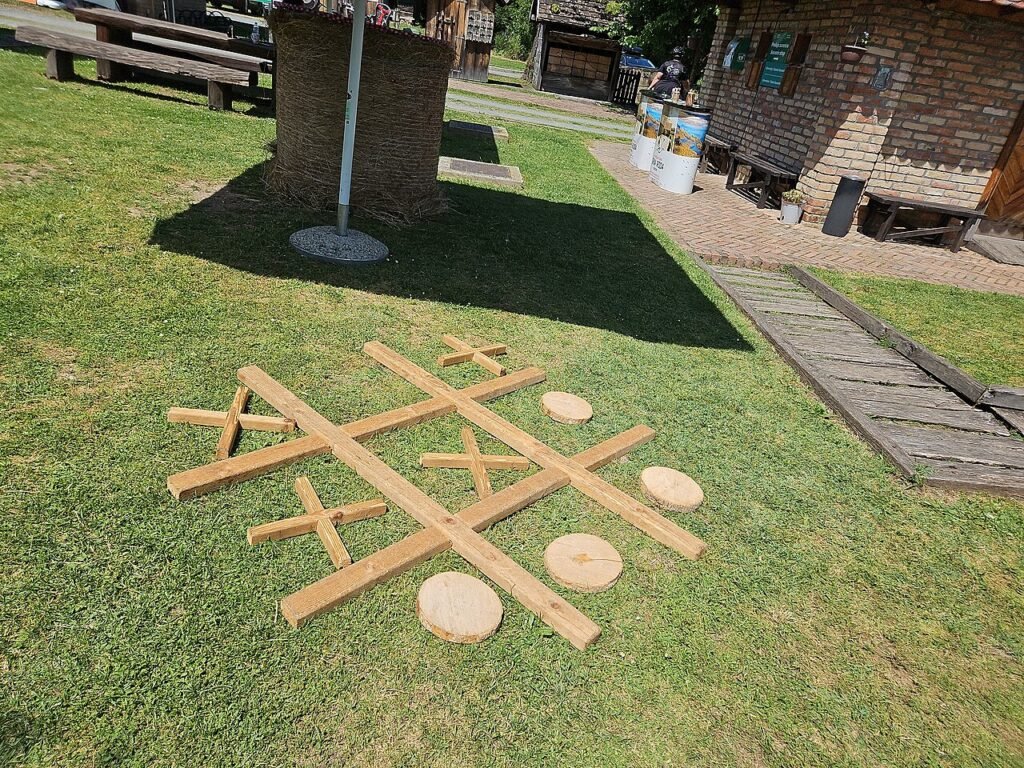
The same game plays differently in each place. Tic-Tac-Toe on a table is a quiet game. Tic-Tac-Toe on a giant scale, with wooden pieces on grass, is a garden game. The rules are the same, but the setting changes everything. A paper game is not just a game. It is a game that goes where you go.
How to Make Paper Games Last Longer
A paper game ends, but it does not have to be over. Play best of three instead of one round. Keep a running score across the day, and crown a champion at bedtime. Change one rule and play again: tic-tac-toe on a four-by-four grid, hangman with only animal words, dots and boxes on a bigger grid. Small changes make old games feel new.
Make a games book. Staple ten sheets of paper together, write the rules of your favourite games on the first page, and keep the book in the car or in a school bag. Children love a book that belongs to them, and they will ask to play from it. Let them add their own games to the book, with their own rules written in their own words. A games book that a child helped to make is a games book that gets used.
Teach a game to someone else. The best way to learn a paper game properly is to teach it. Let the older child teach the younger one. Let the child teach the parent. Teaching a game is a game in itself, and it is how paper games have been passed down for generations: one child showing another, with nothing but a pencil and a sheet of paper.
Frequently Asked Questions
What is the best paper game for kids?
Tic-Tac-Toe is the best first paper game: it takes thirty seconds to learn and it works for ages four to adult. After that, Hangman is the best word game, Dots and Boxes is the best strategy game, and The Drawing Game is the best game for laughing. If you learn those four, you have a paper game for every mood.
Do paper games really need no supplies?
Yes. Every game in this guide needs only paper and a pencil. If you have no paper, use the back of a receipt, a napkin, or a page from a notebook. If you have no pencil, use a pen, a crayon, or a stick in the sand. The games are about the rules, not the materials, and the rules work on any surface you can draw on.
Can paper games help children learn?
Yes. Hangman teaches spelling. Word Chain teaches vocabulary. Dots and Boxes teaches strategy. Battleships teaches coordinates. The Quiz Game teaches whatever subject you choose. Paper games teach without feeling like lessons, because the learning is inside the game, not on top of it. Children practise spelling, counting, and thinking while they are having fun.
What age are paper games for?
Paper games work from age four to adult. Younger children play Tic-Tac-Toe and drawing games. Older children play Battleships, Word Ladders, and Paper Chess. The same game grows with the child: a six-year-old plays hangman with three-letter words, and a twelve-year-old plays it with words from a science textbook.