
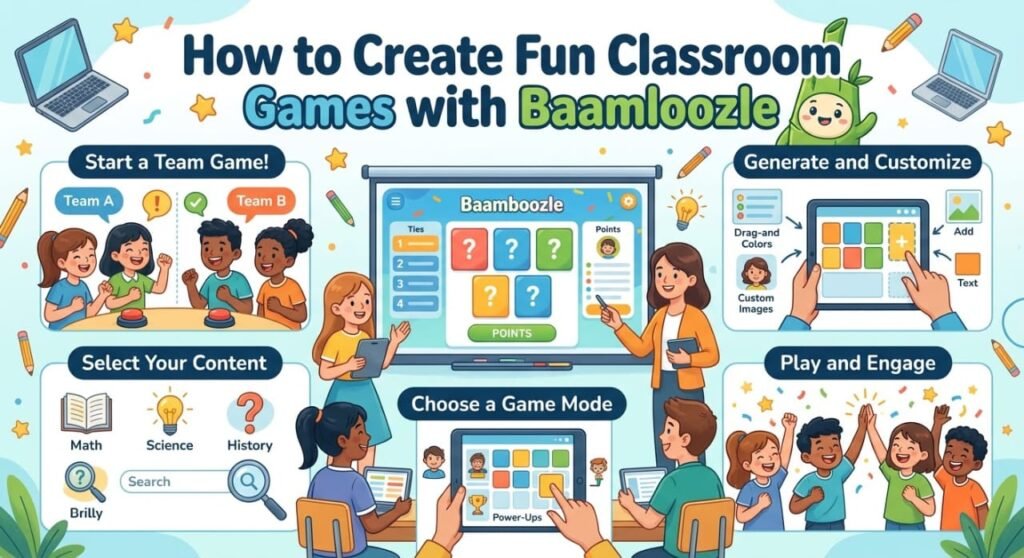
In today’s classrooms, students do not always learn best by simply reading textbooks or listening to long explanations. Sometimes, a little competition, teamwork, and fun can make a lesson much more memorable. This is where Classroom Games with Baamboozle can help teachers turn ordinary lessons into engaging learning activities.
Baamboozle.net is an online platform designed around educational games and interactive quizzes. Teachers can use games for revision, classroom practice, team challenges, warm-up activities, and more. The platform is especially useful when you want students to participate instead of simply sitting and listening.
The best part is that you do not need to be a technology expert to create a simple classroom game. With a few questions, answers, and a clear learning goal, you can build an activity that makes students excited to participate.
What Are Classroom Games with Baamboozle?
Classroom Games with Baamboozle are interactive educational activities that teachers can use to make lessons more enjoyable and participatory. Instead of giving students a traditional worksheet or quiz, teachers can turn questions into a game where students work in teams, choose questions, answer them, and earn points.
Baamboozle is designed for different types of classroom activities, including quizzes, review games, team challenges, and interactive learning exercises. Its official features page describes the platform as a way to build engaging quizzes and classroom games and invite students to participate.
These games can be used with different subjects and age groups. For example, an English teacher can create vocabulary questions, while a science teacher can prepare questions about the solar system, animals, or human body systems.
The goal is simple: turn learning practice into an activity students want to participate in.
Why Use Baamboozle for Classroom Learning?
Classroom Games with Baamboozle are interactive activities that make lessons more fun and engaging. Teachers can turn questions into team games where students answer questions and earn points.
Baamboozle can be used for quizzes, revision, team challenges, and different subjects. For example, teachers can create vocabulary, science, math, or general knowledge games.
The goal is simple: turn learning into an activity students enjoy.
1. Makes Lessons More Interactive
Instead of answering questions individually on paper, students can discuss answers with their teammates. This creates more opportunities for participation.
2. Encourages Teamwork
Students can work together to solve questions. This can help create communication and collaboration during the lesson.
3. Makes Revision More Enjoyable
Reviewing a topic does not have to mean repeating the same worksheet. A game can turn revision into a friendly challenge.
4. Saves Preparation Time
Teachers can create their own games or use existing educational games from the platform’s library. Baamboozle’s site currently promotes a large collection of teacher-created games.
5. Works Across Different Subjects
You can create questions for English, mathematics, science, history, geography, general knowledge, and many other subjects.
How to Create Classroom Games with Baamboozle
Creating your first game does not need to be complicated. The key is to start with a clear topic and a manageable number of questions.
Step 1: Choose Your Learning Goal
Before creating the game, decide what you want students to learn or review.
For example:
- Review vocabulary
- Practice multiplication
- Revise science facts
- Check reading comprehension
- Practice grammar
- Prepare for a test
- Review a recently completed lesson
Having a clear goal helps you write better questions.
Instead of creating random questions, make sure every question supports the lesson.
Step 2: Select a Topic
Choose one specific topic for your game.
For example, if you are teaching English, your topic could be:
“Present Simple Tense”
Your questions could include:
- What is the present simple tense?
- Make a sentence using “play.”
- Choose the correct verb.
- Change this sentence into a negative sentence.
- Make a question using “does.”
Keeping the game focused makes it easier for students to understand what they are practicing.
Step 3: Create Your Questions
Now prepare questions that match the level of your students.
Try to use a mixture of easy, medium, and challenging questions. If every question is difficult, students may become frustrated. If every question is too easy, the game may quickly become boring.
A good game gradually challenges students.
For younger learners, you can use short questions and simple language. For older students, you can include problem-solving questions, explanations, and discussion-based questions.
Baamboozle’s game creation resources explain that teachers can add a title, description, questions, answers, and visual elements when building games.
Step 4: Add Visuals When They Help
Pictures can make classroom games more interesting, particularly for younger students and language learners.
For example, instead of asking:
“What is this animal?”
you can show a picture and ask students to identify it.
Visual questions can also be useful for:
- Vocabulary
- Animals
- Objects
- Geography
- Science
- Art
- Classroom objects
The important thing is to use images when they support the learning goal rather than adding them just for decoration.
Step 5: Organize Students Into Teams
One of the fun parts of Classroom Games with Baamboozle is team participation.
Divide your class into small groups. Give each team a name and explain the rules before starting.
For example:
- Team A
- Team B
- Team C
- Team D
Each team takes a turn selecting a question. The teacher displays the question, and the team discusses the answer.
This setup can encourage even quieter students to participate because they have teammates who can help them.
Step 6: Explain the Rules Before Playing
Before the first question, take a minute to explain how the game works.
Tell students:
- How teams will take turns.
- How they will select questions.
- How they should answer.
- How points will be awarded.
- What happens if an answer is incorrect.
- Whether other teams can answer after a wrong response.
Clear rules prevent confusion and keep the game moving.
Baamboozle’s platform supports team-based play and score tracking, allowing teachers to manage classroom competitions while students participate together.
Fun Ideas for Classroom Games with Baamboozle
Once you understand the basic process, you can experiment with different types of activities.
Vocabulary Challenge
Choose 15–20 vocabulary words from your current lesson.
Students can be asked to:
- Define the word
- Use it in a sentence
- Give a synonym
- Give an opposite
- Identify a picture
- Spell the word
This works especially well for English-language learning.
Math Challenge
Create questions based on the mathematics topic your students are studying.
For example:
Question: What is 12 × 5?
For more advanced students, you could create word problems that require them to explain their answer.
Science Review Game
Create a game about a science unit.
For example, if students are learning about the solar system, questions could include:
- Which planet is closest to the Sun?
- How many planets are in the solar system?
- What is Earth’s natural satellite?
- Which planet is known for its rings?
This makes revision more active and gives teachers a quick way to check understanding.
True or False Challenge
True-or-false questions are easy to create and quick to answer.
For example:
“The Earth revolves around the Sun.”
Students decide whether the statement is true or false and explain their answer.
This can be useful as a quick lesson review.
Picture Guessing Game
Show a picture and ask students to identify it.
You can use this idea for:
- Animals
- Countries
- Famous places
- Food
- Objects
- Vocabulary
- Scientific diagrams
Picture-based games can be especially useful for younger students.
Use Baamboozle as a Lesson Warm-Up
You do not always need an entire lesson for a game. Classroom Games with Baamboozle can also be used as a quick warm-up at the beginning of class.
For example, prepare five questions about the previous lesson and give students a few minutes to answer them as teams. This helps students remember what they learned before moving to a new topic.
Baamboozle games can also be useful for concept checking, revision, and other interactive classroom activities.
Use Games for Revision
Revision is another natural use for Classroom Games with Baamboozle.
Before a test, create a review game containing important concepts from the unit.
You can divide questions into different difficulty levels. Start with simple recall questions and finish with questions that require students to apply what they have learned.
This gives teachers an informal way to see which concepts students understand and which areas may need more explanation.
Make the Game Suitable for Your Students
A successful classroom game should match the students’ age, ability, and learning needs.
For younger children:
- Use simple language.
- Keep questions short.
- Add visuals.
- Use familiar topics.
- Keep the pace active.
For older students:
- Use more challenging questions.
- Include problem-solving.
- Ask students to explain answers.
- Add questions that encourage discussion.
- Connect questions to real-life situations.
Remember that the purpose is not simply to create a competition. The game should help students learn.
Keep Competition Friendly
Competition can make games exciting, but it should remain positive.
Encourage students to celebrate correct answers without making other teams feel bad when they lose points.
You can also reward effort, teamwork, participation, or improvement rather than focusing only on the final score.
This helps create a classroom environment where students feel comfortable trying even when they are not completely sure about an answer.
Let Students Explain Their Answers
One simple way to make Classroom Games with Baamboozle more educational is to ask students to explain their answers.
For example, instead of saying:
“What is the answer?”
ask:
“What is the answer, and why?”
This small change encourages students to think more deeply.
It also allows teachers to identify misunderstandings that may not be obvious from a simple correct-or-incorrect response.
Explore Existing Baamboozle Games
You do not always have to start from zero.
Baamboozle provides a library of educational games created for classroom use, so teachers can search for activities related to their subject or topic.
This can save preparation time.
For example, if you are teaching English vocabulary, search for games related to the vocabulary topic you are currently covering. You can then choose an appropriate activity or use an existing game as inspiration for your own.
The platform’s resources also explain that teachers can save games and create their own activities for repeated classroom use.
Common Mistakes to Avoid
While creating games, avoid making every question complicated.
A good classroom game should be easy for students to understand and easy for the teacher to manage.
Avoid:
- Questions that are unnecessarily long
- Topics unrelated to the lesson
- Too many difficult questions
- Rules that students do not understand
- Games that take too long
- Competition that becomes negative
Also, remember that the game is a teaching tool. If students are having fun but are not learning anything, the questions need to be improved.
Final Thoughts
Creating Classroom Games with Baamboozle can be a simple way to bring more energy into everyday teaching. Instead of relying only on textbooks, worksheets, and traditional revision activities, teachers can use games to encourage teamwork, participation, discussion, and active recall.
Start with one topic, create a small set of useful questions, divide your students into teams, and explain the rules clearly. As you become more comfortable, you can experiment with vocabulary challenges, picture games, science quizzes, mathematics activities, revision games, and other classroom challenges.
The most important thing is to connect every game to a learning goal. When educational content and playful activities work together, students can practice important skills while enjoying the learning process.
Whether you are preparing a quick warm-up, reviewing a difficult topic, or planning a fun end-of-lesson activity, Classroom Games with Baamboozle can give you a flexible way to make your classroom more interactive and memorable.