
A long flight with children and no screens sounds like a challenge, but it is also an opportunity. Without a tablet to stare at, children talk, draw, imagine and play together, and the games that work best on a plane are the old ones: guessing games, word games, drawing games and quiet challenges that fit on a tray table and need nothing more than a pencil and a little patience.
This guide gives you more than twenty games for kids on a plane no screens needed, organised by age and by how much space they take. Every game is quiet enough for a cabin, small enough for a tray table, and simple enough to start in under a minute. There is also a packing list, an age guide, and tips for the hard parts of a flight: take-off, landing, and the restless middle hour.
Why No-Screen Games Work on a Plane
Screens are the easy answer on a flight, but they have real limits. Batteries run out, headphones break, and a child who has watched a screen for three hours is often more restless, not less. No-screen games have the opposite effect: they use the child’s own imagination, they can be played with a parent or a sibling, and they can be stopped and started without losing anything.
No-screen games also solve the space problem. A tray table is about the size of a school desk cut in half, and most toys do not fit on it. A guessing game needs no space at all. A drawing game needs one small notebook. A card game needs a deck of cards and a steady hand. Everything in this guide was chosen to fit in that space.
The other advantage is quiet. A plane cabin is a shared space, and a game that needs shouting will earn glares from the row in front. Every game here can be played in a whisper or in silence, and the loudest thing in most of them is a giggle.
Packing the Plane Game Bag
You do not need much, but what you pack matters. Put it all in one small bag that fits under the seat, so you are not digging through the overhead locker mid-flight.
Pack a small notebook and two pencils for each child, plus a pencil sharpener with a covered blade. Pack a deck of cards, a few stickers, and a small pack of crayons rather than felt-tip pens, because crayons do not dry out and do not mark the seats. Pack a tiny pad of sticky notes: they are useful for guessing games, for drawing challenges, and for leaving notes for each other.
Pack one surprise per hour of flight, wrapped in paper. A small toy, a new pencil, a sticker sheet, or a tiny puzzle. The wrapping is part of the game: a child who unwraps a small gift mid-flight gets a fresh burst of energy.
Do not pack anything with small pieces that roll, anything noisy, or anything that needs a table bigger than a tray. Leave the board games with twenty pieces at home. Leave the toy with the siren at home too.
Games by Age: A Quick Guide
Ages two to four need games with almost no rules. Looking games, naming games, and simple songs work best. Keep each game to five minutes, and switch often, because a toddler’s attention span is short even on the ground.
Ages five to seven can handle simple rules, short rounds, and games with a winner. Guessing games, drawing games and simple word games are the sweet spot. They can also play card games with help, and they love games where they get to be the one who hides or the one who chooses. If you want more ideas in this age range, the collection of Baamboozle games for kindergarten is built around the same simple, playful style.
Ages eight to eleven can play everything on this list, including the strategy and word games. They can keep score, they can play in teams, and they can invent their own variations. Give them the notebook and let them run a game for a younger sibling: it keeps both children busy.
Ages twelve and up will enjoy the strategy games, the word games, and the drawing challenges, especially if there is a real contest involved. Let them keep score, let them choose the games, and let them teach a game to the family. A teenager who is running the game is a teenager who is not bored.
Tray-Table Games: 8 Games That Need Only Paper and a Pencil
1. Paper Plane Contest
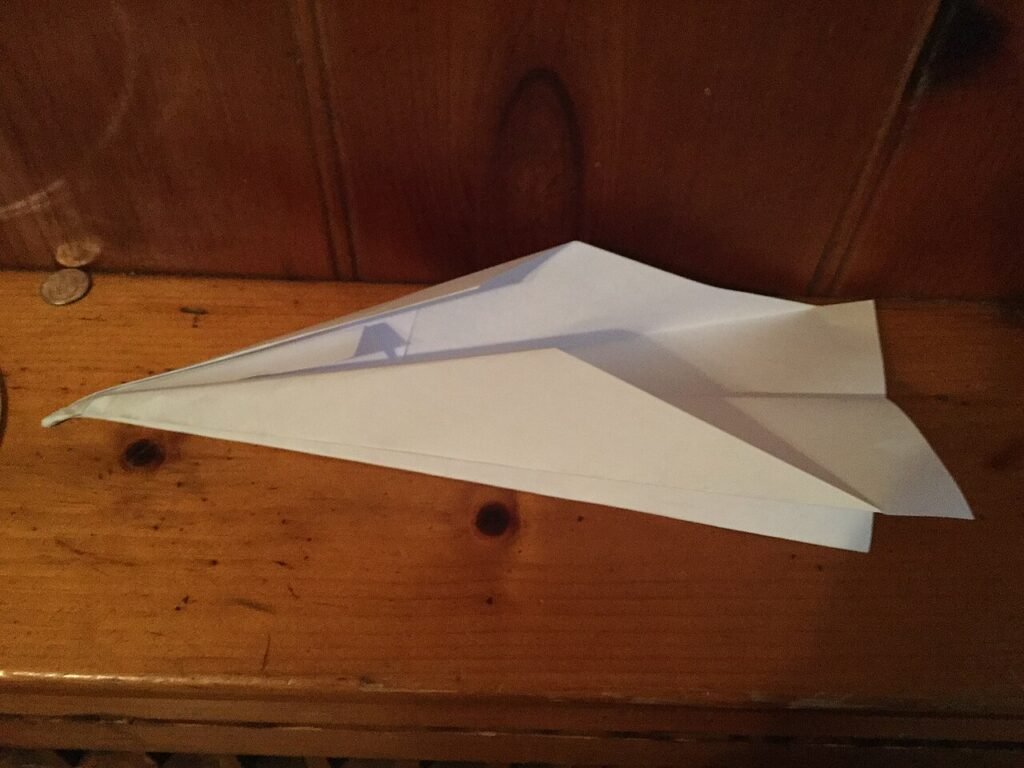
Fold a paper plane, fly it down the aisle when the seat-belt sign is off, and see whose plane goes furthest. Give points for distance, for the best landing, and for the prettiest design. The classic dart design is the easiest to fold, and there are endless variations to try: wide wings for slow floating, narrow wings for speed. The paper plane article explains the basic designs and the physics behind them.
2. Hangman
One player thinks of a word and draws a dash for each letter. The other players guess letters one at a time. A correct letter fills in everywhere it appears, and a wrong letter adds a part to the hangman. Use words from the holiday: the place you are flying to, animals, foods, or the names of family members. Best for ages six and up.
3. Noughts and Crosses Tournament
The classic three-by-three grid, played as a tournament. Each player gets a turn, the winner stays on, and the loser passes the notebook to the next player. Keep a running score on the side of the page. For older children, try the four-by-four version, which is harder than it looks.
4. Dots and Boxes
Draw a grid of dots, and take turns drawing a line between two dots. When you complete a box, you write your initial in it and take another turn. The player with the most boxes at the end wins. It looks simple, but it is a real strategy game.
5. Drawing Challenge Cards
Write ten drawing challenges on sticky notes: draw a dragon, draw your dream house, draw the funniest animal you can imagine. Each player draws one, and everyone draws at the same time. Vote on the best drawing, and the winner picks the next challenge.
6. Battleships on Paper
Each player draws a ten-by-ten grid and hides five ships in it. Players take turns calling out coordinates, and mark hits and misses. It is quiet, it takes twenty minutes, and it is one of the best tray-table games for older children.
7. Word Ladders
Write a word at the top of the page, and change one letter at a time to reach a new word at the bottom. CAT becomes BAT, then BET, then BEE. Give younger children three steps, and older children five.
8. The Doodle Game
One player draws a squiggle, and the other player has to turn it into a picture. A wavy line becomes a snake, a circle becomes a face, a zigzag becomes a mountain. It is the best game on this list for younger children, because there is no way to lose.
Talking Games: 7 Games That Need No Equipment at All
9. I Spy
One player picks something they can see and says “I spy with my little eye, something beginning with…” The others guess. On a plane, the objects are limited to the cabin: seats, windows, bags, books, and the view outside. For younger children, use colours instead of letters: “I spy something blue.”
10. Twenty Questions
One player thinks of a person, place or thing, and the others ask up to twenty yes-or-no questions. On a plane, limit the topic to things to do with travel, animals, or food, so the game does not stall.
11. The Alphabet Game
Pick a category, such as animals or foods, and go through the alphabet naming one thing for each letter. A for apple, B for banana, C for cherry. For older children, add the rule that you cannot repeat an answer.
12. Fortunately, Unfortunately
One player starts a story with a fortunate event: “Fortunately, we found a treasure map.” The next player adds an unfortunate twist: “Unfortunately, the map was torn in half.” The story alternates, and it gets stranger with every turn.
13. Would You Rather
Ask a pair of choices: would you rather fly or be invisible, live in a castle or on a boat, eat only pizza or only ice cream for a year? Everyone answers, and then everyone explains why. There is no winner, which makes it the best game for children who do not like losing.
14. The Memory Game
One player says “I packed my bag and in it I put a toothbrush.” The next player repeats the list and adds an item. The list grows, and the player who forgets an item is out.
15. Guess the Animal
One player thinks of an animal and gives three clues, one at a time. The others guess after each clue, and the player who guesses after the fewest clues wins. For younger children, use animal sounds as clues.
Quiet Challenges: 7 Games for the Restless Middle Hour
16. Spot the Difference, Made by You
One player draws a simple picture, and the other player studies it for thirty seconds, then closes their eyes while the first player changes three things. The second player opens their eyes and finds the changes.
17. The Quietest Game
The challenge is simple: be the quietest person for five minutes. The first person to speak, laugh out loud, or make a noise loses. It sounds silly, but children take it seriously, and it is the best game for a moment when the cabin is settling down for a rest.
18. Sticker Story
Give each child a sticker sheet and a notebook page. They have to make up a story using the stickers as characters and props, and then tell the story to the family. It combines drawing, storytelling and stickers, and it keeps a child busy for twenty minutes without a sound.
19. Card Games: Snap, Go Fish and War
A deck of cards fits in a pocket and fills an hour. Snap is the fastest: flip cards, and slap the pile when two match. Go Fish is the best for younger children, because the rules are simple and the game is gentle. War is the simplest of all: each player flips a card, and the higher card wins the round.
20. Make a Travel Journal
Give each child a notebook and ask them to keep a journal of the flight: draw the view from the window, write down three things they can see, and write one sentence about how they feel. The journal becomes a souvenir of the trip.
21. The Window Game
Look out of the window and take turns describing what you see: clouds, fields, rivers, roads, other planes. Give a point for the most interesting thing spotted, and a bonus point for the first person to spot something specific, like a river or a town.
22. Finger Puppets and Shadow Stories
Make simple finger puppets from sticky notes, or use hands to make shadow animals on the seat-back screen. Tell a short story with the puppets, and let each child add a character. It is the best game for toddlers, because it needs no reading and no rules.
The Hard Parts: Take-Off, Landing and the Restless Hour
Take-off and landing are the hardest moments, because children must stay seated and cannot move around. Save a new game for take-off: a fresh notebook page, a new sticker sheet, or a surprise from the game bag. The novelty carries a child through the twenty minutes when they cannot get up.
The restless hour usually comes about halfway through a long flight. The child has played three games, eaten the snack, and is bored. This is the moment to change the type of game, not the game itself. If you have been playing talking games, switch to a drawing game. A change of activity resets attention better than a new game of the same type.
If a child is upset or overtired, stop the games. A tired child does not need a game; they need a rest, a drink, and a quiet cuddle. The games will still be there when they wake up.
Tips for Flying With More Than One Child
Give each child their own notebook and pencils, so there is nothing to fight over. Let the older child teach a game to the younger one: it keeps both busy, and the older child feels important. Keep score on a shared page, and make the scoring kind: points for trying, points for funny answers, and a small prize for everyone at the end.
If siblings start arguing over a game, change the game, not the rules. Arguing about rules is the fastest way to ruin a flight, and a new game resets the mood. The quietest game and the drawing challenge are the best reset games, because they have no winner and nothing to argue about.
Frequently Asked Questions
What age can play games for kids on a plane no screens?
Children from two years old can play the looking and naming games, and children from five can play the guessing and drawing games. The full list here covers ages two to twelve, and the age guide above says which games suit each age. For teenagers, the strategy games, Battleships and the word games work best.
How do I keep games quiet on a plane?
Choose games that are played by whispering, writing or drawing, and set the rule before you start: indoor voices only. The talking games in this guide are designed to be played quietly, and the tray-table games make no noise at all. If a game gets loud, switch to a drawing game for ten minutes.
What should I pack for no-screen plane games?
A small notebook and two pencils per child, a deck of cards, crayons, sticky notes, a sticker sheet, and one small wrapped surprise per hour of flight. That is everything the games in this guide need, and it all fits in a small bag under the seat.
Are these games suitable for a long-haul flight?
Yes. The list has twenty-two games, and most of them take ten to twenty minutes, so there is enough here for a flight of several hours, especially if you mix talking games, drawing games and card games. Save the best games for the middle of the flight, when children are most restless, and save a surprise from the game bag for the last hour.