
Social gatherings, virtual team syncs, and family game nights thrive on conversation. While complex board games and trivia tournaments have their place, party hosts and facilitators increasingly rely on accessible, low-pressure activities that immediately get people talking. Among the most enduring conversation starters is the worse or worst game, an interactive decision-making activity built around forced dilemmas, subjective moral scales, and funny debates.
Worse or Worst
Which one is worse? Test your annoyance instincts.
Scores are just a fun “badness” rating (1–100). Don’t take them too seriously.
At its core, the game challenges participants to confront a series of unpleasant, awkward, or impossible scenarios and make a choice. Depending on how the rules are structured, players must decide which of two tough choices is the worse option, or evaluate a list of several terrible situations to determine the absolute worst. What sounds like a straightforward exercise quickly turns into an energetic battle of wits, personal priorities, and psychological reveals.
Understanding how the worse or worst game works, why it holds such universal appeal, and how it can be adapted across diverse environments highlights how simple conversational tools can build meaningful social connections. Whether used in corporate workshops, digital classrooms, road trips, or party circles, this activity demonstrates that exploring bad options can produce positive social outcomes.
Conceptual Origins and the Evolution of Dilemma Games
The roots of the worse or worst game stem from centuries of philosophical thought experiments and classic parlor games. For generations, philosophers have used hypothetical moral dilemmas, such as the famous trolley problem, to explore human ethics, utilitarian calculations, and instinctual behavior. These academic inquiries proved that forcing individuals to choose between undesirable options reveals deep insights into personal values.
In the twentieth century, these thought experiments crossed over into casual social entertainment. Games like Would You Rather established the appeal of binary choices, requiring players to choose between two unusual or comedic circumstances. As social gaming evolved into the digital era, the worse or worst game emerged as a focused variation that shifts the spotlight to negative optimization. Instead of asking what a person prefers, it asks players to diagnose what they fear, detest, or avoid most.
The rise of digital culture and party gaming formats has elevated this concept into card games, mobile party apps, and viral social media challenges. Audiences enjoy observing how others rank everyday annoyances, social blunders, and extreme crises. The modern format blends philosophical inquiry with lighthearted improv comedy, making it an engaging staple of contemporary group entertainment.
How the Worse or Worst Game Operates
The structure of the worse or worst game can be tailored to the size and preferences of the group, functioning either as an informal icebreaker or a structured points-based tournament. The mechanics fall into two distinct play styles based on linguistic comparison.
In the comparative format, which focuses on identifying what is worse, the game functions as a head-to-head matchup. A host, card prompt, or rotating player presents two undesirable scenarios. For instance, a player might be asked whether it is worse to forget an important anniversary or to accidentally send a complaining message about your boss to the boss directly. The player or group must evaluate both situations, weigh the consequences, and pick which option represents the greater misfortune.
In the superlative format, which centers on crowning the single worst item, the round expands to include three or more options. A card or host might present four disastrous holiday travel setbacks, such as losing luggage, missing a connecting flight, getting food poisoning in transit, or sitting next to a continuously crying toddler on an overseas journey. Participants debate all four scenarios until they determine which one occupies the absolute bottom of the scale.
Scoring can be implemented to add friendly competition. In popular commercial adaptations, a rotating judge chooses their verdict in secret, while the rest of the players predict what that judge will decide. Points are awarded to players who accurately read the judge’s personality and anxieties. In cooperative modes, the whole group attempts to reach a unanimous verdict, arguing the merits of each scenario until everyone agrees on the final ranking.
Core Mechanics and Key Features of the Activity
What makes the worse or worst game continuously replayable is its clean, adaptable framework. The game requires zero elaborate equipment, expensive boards, or lengthy rule manuals. A simple deck of prompt cards or a creative host with a list of inventive dilemmas is enough to start a session in seconds.
A standout feature is the diversity of scenario categories. Skilled game designers and hosts divide prompts into relatable everyday problems, absurd hypothetical emergencies, professional nightmares, and philosophical quandaries. Everyday dilemmas might involve minor inconveniences like lukewarm coffee or a battery dying at five percent, while extreme prompts could involve surviving a zombie apocalypse with incompetent teammates. This range allows the game to shift from light comedy to deep discussion based on the room’s mood.
Another defining element is the role of subjective justification. The game is never just about blurting out an answer; the genuine entertainment comes from the justification that follows. A participant cannot simply declare that spilled soup is worse than losing their keys; they must walk the room through the emotional fallout, the logistics of cleanup, and the ruined afternoon. The debate phase transforms a simple choice into an engaging piece of personal storytelling.
Psychological Appeal and Social Dynamics
The persistent appeal of the worse or worst game lies in how it safely taps into vulnerability, empathy, and psychological projection. Confronting bad situations is normally stressful, but doing so within a structured, hypothetical game creates psychological safety.
Psychologists note that humor often arises from benign violations, which are events that feel slightly wrong or threatening but are ultimately harmless. Deliberating over catastrophic or embarrassing scenarios in a supportive living room or friendly call allows people to laugh at real anxieties. Discussing terrible dates, public speaking disasters, or travel nightmares neutralizes their sting by turning them into shared human experiences.
The game also acts as an engaging personality test. When someone chooses between losing their smartphone or losing their wallet, they are revealing how they navigate autonomy, security, and digital dependency. Observers learn whether their friends are driven by convenience, reputation, financial prudence, or physical comfort. These revelations happen organically without the forced awkwardness common in traditional team-building questionnaires.
Benefits in Educational and Professional Environments
While often played over drinks or during family gatherings, the worse or worst game serves practical purposes in structured professional and educational settings. Modern workplaces and university classrooms frequently need activities that break social barriers and teach soft skills without feeling forced.
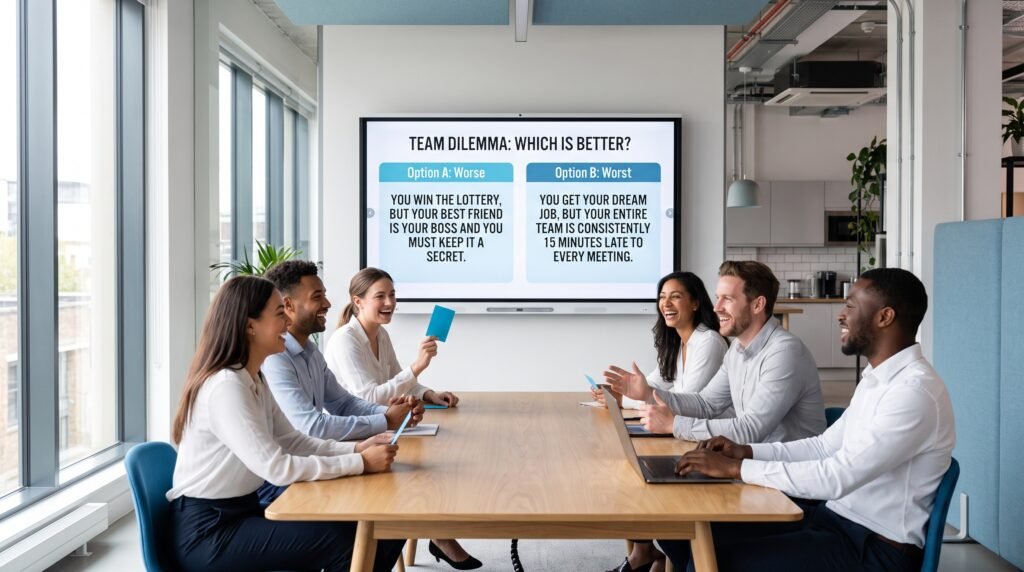
In corporate team-building, the game helps colleagues understand each other’s communication styles and risk tolerances. When project teams debate which project management catastrophe is worse, team members uncover differing views on deadlines, quality control, and client transparency. A team that can debate lighthearted worst-case scenarios with mutual respect develops the psychological safety needed to handle real workplace crises constructively.
In language learning and public speaking classrooms, the format provides an engaging rhetorical exercise. Students practicing English as a second language frequently struggle with the grammatical distinction between comparative adjectives like worse and superlative adjectives like worst. Playing a game built on these words reinforces proper grammatical structures naturally through speech. Furthermore, requiring students to construct logical arguments to defend their picks builds impromptu debate skills, vocabulary breadth, and persuasive confidence.
Practical Scenarios and Adaptations for Different Audiences
One of the greatest assets of the worse or worst game is its flexibility across different ages, group sizes, and mediums.
For family game nights and younger children, the scenarios can focus on silly, imaginative dilemmas. Kids love debating whether it is worse to eat broccoli-flavored ice cream or wear shoes made of wet sponges for a day. In this context, the game encourages critical reasoning and descriptive vocabulary while keeping the atmosphere light and whimsical.
For college dorms, adult dinner parties, and casual friend circles, the prompts often tilt toward social awkwardness, dating faux pas, and lifestyle challenges. Debating whether it is worse to be caught snooping on someone’s social media or to arrive at a costume party on the wrong day invites humorous personal anecdotes, prompting friends to share stories of real-life mishaps.
The game translates seamlessly to remote work cultures and virtual environments. In an era where distributed teams battle video call fatigue, opening a meeting with a two-minute dilemma jumpstarts participation. A manager can post two undesirable technical hurdles into a chat channel and ask colleagues to vote on which is worse, instantly sparking chat room banter before pivoting to the workday agenda.
How to Curate and Run a Successful Game Session
Running a memorable session of the worse or worst game requires thoughtful pacing, empathetic reading of the room, and balanced prompt curation. A host who understands their audience ensures the experience remains entertaining rather than uncomfortable.
A successful session begins with establishing appropriate boundaries. Because the game explores negative outcomes, certain topics such as genuine personal trauma, serious medical crises, or sensitive political issues can dampen the mood if introduced carelessly. An observant facilitator keeps scenarios centered on relatable annoyances, playful hypotheticals, and universal social blunders, ensuring the content stays enjoyable for all participants.
Pacing is equally critical. The host should prevent arguments from dragging on too long over a single prompt. Once both sides of a dilemma have presented their main points and the room has shared a laugh, the host should call for a final show of hands, record the votes, and introduce the next scenario to keep energy high.
Mixing the stakes across rounds helps sustain engagement. Alternating between trivial, low-stakes questions and dramatic, high-stakes moral puzzles keeps participants guessing. Following a silly debate about soggy socks with a strategic debate about wilderness survival mechanics maintains curiosity throughout the session.
The Cultural Longevity of Negative Choice Entertainment
Society has always found entertainment in exploring adversity from a safe distance. From television game shows built around risk avoidance to comedy routines analyzing daily miseries, people gravitate toward content that finds humor in imperfection.
The worse or worst game endures because it mirrors everyday decision-making. Life rarely presents choices between flawless options; more often, people navigate compromises, manage trade-offs, and choose the least disruptive path forward. By turning this fundamental life experience into a playful exercise, the game validates everyday frustrations while providing shared laughs.
As social interactions balance physical spaces and online platforms, the simplicity of dilemma-based activities ensures their lasting relevance. No matter how technology evolves, the appeal of challenging someone to defend an absurd choice remains timeless.
Conclusion
The worse or worst game proves that compelling entertainment does not rely on complicated rulebooks or high-tech equipment. By inviting players to confront bad, awkward, and exaggerated dilemmas, the activity turns negative choices into an engaging platform for humor, connection, and creative thought.
From sharpening comparative language skills to fostering workplace camaraderie and enlivening dinner parties, the game adapts to any setting with ease. It allows participants to share their outlooks, test their principles, and celebrate the messy realities of the human experience. When you gather a group to explore what is worse or decide on the absolute worst, you discover that debating bad options can be one of the best ways to bring people together.
Frequently Asked Questions
What is the worse or worst game?
The worse or worst game is a social conversation activity where players evaluate two or more undesirable, awkward, or difficult scenarios and debate which option is the least desirable. Players choose which of two choices is worse, or review a broader list to determine which scenario is the absolute worst, sparking engaging debates and personal stories along the way.
How does this activity differ from Would You Rather?
While the two games share similar dilemma-based structures, they approach choices from opposite angles. Would You Rather generally asks players to identify the option they prefer, often including positive, exciting, or beneficial scenarios. In contrast, this activity deals exclusively with negative dilemmas, asking participants to weigh trade-offs and pinpoint the greater misfortune.
Can the game be played without buying a commercial card deck?
Yes, the game requires no commercial purchases or proprietary materials to play. Anyone can host a game by inventing dilemmas on the spot, drawing from funny personal anecdotes, or brainstorming relatable everyday annoyances. A host simply needs to present two or three challenging options to a group to begin a round of discussion.
Is the game suitable for professional team-building sessions?
Yes, the game is frequently adapted for professional team-building, orientation seminars, and collegiate icebreakers. When questions focus on workplace scenarios, creative project hurdles, or lighthearted lifestyle dilemmas, the activity builds psychological safety, uncovers communication styles, and encourages friendly dialogue without crossing personal boundaries.
What makes a prompt engaging in the worse or worst game?
The most effective prompts present closely balanced alternatives that lack an obvious answer. If one scenario is minor and the other is catastrophic, the debate ends immediately. A great prompt forces players to weigh distinct categories of inconvenience, such as trading an immediate public embarrassment against a lingering financial headache, making the choice genuinely difficult and engaging to defend.