
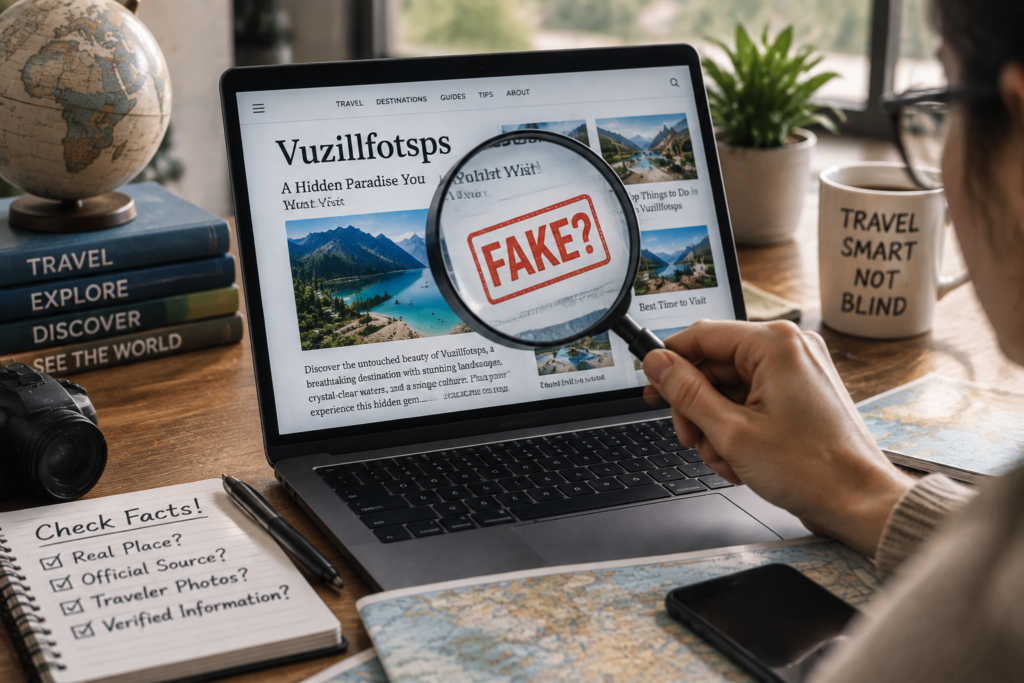
If you searched “to visit Vuzillfotsps” and landed here, you’ve probably already noticed something strange. Dozens of travel blogs describe it as a breathtaking hidden gem. Some call it a mountain region with glacial lakes. Others describe secluded beaches. One article mentions “zeluk root stew” and “Vuzberry tarts.” Another lists caves, waterfalls, and a “Tiflor Ridge Trail” that no other source mentions at all. If you’ve tried cross-referencing any of this against an actual map, a government tourism board, an airline route, or even a single geotagged photo, you’ve come up empty.
That’s because To Visit Vuzillfotsps does not exist. There is no country, region, town, or landmark by that name anywhere on Earth. What you’re looking at is one of the clearest examples circulating online right now of a fabricated travel destination, almost certainly generated with AI writing tools and published purely to capture search traffic around an invented keyword. This article exists to do something the dozen or so articles ranking above it don’t: tell you the truth, explain how this happened, and help you recognize the pattern the next time you run into it, because Vuzillfotsps is far from the only one.
What Is To Visit Vuzillfotsps, Really?
The honest answer is that Vuzillfotsps is a made-up word attached to a cluster of AI-generated travel articles. It has no Wikipedia page, no entry in any gazetteer or geographic database, no coordinates that resolve to a real place, and no mention in any legitimate travel guide, government tourism site, or airline destination list. Every detail about it that appears online contradicts every other detail. One site places it near “serene mountain ranges and sparkling blue waters.” Another describes “lush highland forests and crystal-clear glacial lakes.” A third talks about “secluded beaches” alongside “rolling hills.” If this were a real place, these descriptions would broadly agree with each other, the way genuine travel writing about, say, the Azores or Bali tends to converge on the same landmarks, foods, and geography even when written by different authors. Instead, every Vuzillfotsps article seems to be independently inventing its own version of the place from scratch.
Even the practical details fall apart under scrutiny. None of the articles list a country. None mention a nearby airport, a currency, a language spoken locally, a visa requirement, or a time zone, all things that appear almost automatically in genuine travel content because real travelers actually need that information to plan a trip. The “food” mentioned, things like zeluk root stew or fostan flatbread, doesn’t correspond to any real cuisine, region, or language on record. These are the telltale signs of text generated to sound descriptive and appealing without any underlying factual anchor, because there isn’t one.
Why Vuzillfotsps Is Suddenly Everywhere Online
If Vuzillfotsps isn’t real, why does a search for it return so many results, some of them fairly polished, fairly long, and structured like professional travel guides? The answer has less to do with travel and everything to do with how search-driven content marketing works in 2026.
Someone, likely a content farm, an SEO experiment, or a link-building operation, appears to have picked “Vuzillfotsps” as an invented, brandable-sounding word specifically because it had no existing search competition. A completely made-up term guarantees there’s no established authority site to outrank, no Wikipedia page dominating page one, no government tourism board with decades of domain trust. For a website trying to rank quickly with minimal effort, that’s an appealing shortcut. Once one site published an AI-generated “guide” to this nonexistent place and it started appearing in search results or in an AI-powered answer engine’s training or retrieval data, other sites appear to have picked up the term and generated their own competing versions, each one riffing on invented details from whichever article the AI tool pulled from during generation. This is how a completely fictional word snowballs into an entire ecosystem of “travel guides” within the space of a year or two.
This pattern has a name in the SEO and content-integrity world: scaled content abuse, sometimes just called AI content spam. It refers to publishing large volumes of low-effort, often factually empty content, generated quickly and cheaply, purely to capture search traffic on keywords that either have genuine demand or, in cases like this one, demand that the content itself artificially created. Once a term like “Vuzillfotsps” starts showing up in enough places, curious searchers start typing it in, which generates real search volume, which then shows up in keyword research tools, which then attracts more content creators looking for “low competition, decent volume” keywords to target, without necessarily stopping to check whether the underlying subject is real.

The Anatomy of a Fabricated Destination Article
It’s worth walking through exactly how these articles are constructed, because once you see the pattern, it becomes much easier to recognize in the wild, on this keyword and on countless others like it.
Fabricated destination content almost always follows a predictable structural template. It opens with an emotionally evocative hook, phrases like “hidden gem,” “off the beaten path,” “a place that feels found rather than sold,” language chosen to sound inviting without needing to reference anything concrete. It then moves into a section describing the geography in vague, sweeping terms: mountains, valleys, lakes, forests, coastlines, usually several of these combined in a way that doesn’t correspond to any single real region’s actual topography. Real destinations tend to be shaped by one or two dominant geographic features; invented ones tend to include a little of everything, because the AI generating the text is drawing on the statistical pattern of “what an appealing destination description sounds like” rather than describing an actual place.
From there, the articles typically introduce a handful of invented proper nouns, fictional landmarks with evocative names like “Whispering Caves,” “Silverwater Falls,” “Starlight Meadow,” or “Crystal Lake Viewpoint.” These names are deliberately generic and pleasant-sounding, built from common travel-writing vocabulary, so they read as plausible without being verifiable. Crucially, these invented landmarks rarely appear consistently across multiple articles about the same destination, because each article is generated somewhat independently, sometimes lightly paraphrasing or remixing an earlier fabricated article rather than describing anything real.
The articles then usually pivot to food and culture sections describing invented dishes and vague cultural practices, “centuries-old villages,” “women artisans,” “age-old festivals,” all phrased in a way that could apply to almost any rural region anywhere in the world. This is followed by a “best time to visit” section that, tellingly, tends to be generic seasonal advice, without the specific climate data, rainfall patterns, or shoulder-season pricing insight that a real travel guide, written by someone who has actually researched or visited a place, would typically include.
Finally, nearly every one of these articles ends with a call to action urging readers to “plan their trip” or “discover the magic” of the destination, often followed by an FAQ section that recycles the same vague claims already made in the body text, phrased as questions and answers purely to capture featured snippet space in search results.
Why AI-Generated Fake Destinations Are Multiplying
Vuzillfotsps isn’t an isolated incident. It’s a symptom of a much larger shift in how content gets produced and distributed online. Large language models made it possible to generate long, fluent, structurally sound articles in seconds, at essentially zero marginal cost. For a certain kind of low-quality content operation, that changes the economics of publishing entirely. Where a genuine travel writer might spend days or weeks researching, visiting, or at minimum verifying facts about a destination before publishing five thousand words about it, an AI content operation can generate dozens of similarly-sized articles in an afternoon, publish them across a network of sites, and see which ones happen to catch search traffic.
Fabricating an entire destination takes this a step further than simply writing low-quality content about a real place. By inventing the subject itself, these operations sidestep the need for any research at all. There’s no risk of factual contradiction with an established authority source, because there is no established authority source. There’s no competition from genuine local tourism boards, established travel publications, or firsthand traveler blogs, because none of them are writing about a place that doesn’t exist. In a strange way, fabricating the destination is actually easier and lower-risk than writing inaccurately about a real one, which is precisely why this approach has become a recognizable pattern rather than a one-off oddity.
There’s also a financial incentive layered on top of the pure SEO angle. Sites built around invented destinations often carry affiliate links, display advertising, or lead-generation forms disguised as booking tools. Even a modest amount of curious traffic, people like you, searching to understand what Vuzillfotsps actually is, can generate ad impressions or affiliate clicks, which is often the entire business model behind these sites. The content doesn’t need to be true. It just needs to attract a click.

Real-World Cases Similar to Vuzillfotsps
If this feels like a strange one-off, it helps to know that the broader pattern of invented or wildly exaggerated destinations has precedent, even outside the world of pure AI generation. Travel content has always had a soft spot for hyperbole, but what’s happening with terms like Vuzillfotsps represents something categorically different: not exaggeration about a real place, but total fabrication of the place itself.
In the years since large language models became widely accessible, a number of similarly structured “hidden gem” articles have surfaced around invented place names, often following nearly identical structural templates to what’s been laid out here: evocative opening hook, invented geography combining multiple landscape types, a handful of fancifully named landmarks, vague cultural and culinary details, and a generic best-time-to-visit section. Researchers and journalists tracking AI content spam have flagged this exact pattern repeatedly, pointing to it as one of the clearer, more mechanically detectable signatures of mass-produced AI content, precisely because a real destination, by definition, cannot be internally inconsistent across independent sources the way these invented ones consistently are.
There’s a useful parallel here to older internet phenomena, like fake product reviews or fabricated scientific citations, where the goal was never to inform but simply to occupy space in a system, in this case a search engine, that rewards volume and keyword relevance more efficiently than it verifies truth. Vuzillfotsps is simply the travel-content version of that same underlying dynamic.
How These Articles Manage to Rank in Search Engines
It’s worth addressing directly why content like this shows up prominently in search results at all, since search engines are generally assumed to reward quality and accuracy. The uncomfortable answer is that ranking systems are primarily built to evaluate relevance, structure, and engagement signals, not factual truth. An article that’s well-organized, uses proper heading structure, includes an FAQ section formatted for featured snippets, loads quickly, and closely matches the searcher’s exact query wording can perform well in search rankings even if every factual claim inside it is invented, especially when there’s no competing, established source correcting the record.
This is compounded by the keyword research ecosystem itself. Once a fabricated term generates a meaningful number of searches, whether from confused readers, content creators researching the keyword, or automated tools scraping search suggestion data, that search volume becomes visible in tools like the one referenced in this article’s target keyword. That visibility then signals to more content creators that the keyword is “worth targeting,” creating a feedback loop where fabricated demand generates fabricated supply, which in turn sustains and grows the fabricated demand.
Search engines have been actively working to counter this. Google’s ranking systems have introduced specific policies around what’s now officially termed scaled content abuse, targeting sites that publish content primarily to manipulate search rankings rather than to serve genuine user needs, regardless of whether that content was produced by a human, an AI tool, or some mix of both. Enforcement of these policies tends to lag behind the pace at which new fabricated content appears, which is exactly why a cluster of Vuzillfotsps articles can rank reasonably well for a period of months before being identified and demoted or removed. Anyone building a content strategy around this specific keyword should understand that any ranking gains from fabricated destination content are very likely temporary, and increasingly risky from a site-wide trust and quality perspective as search engines refine their detection methods.
The Real Danger of Fake Travel Content
It’s tempting to treat something like Vuzillfotsps as a harmless internet curiosity, a slightly amusing example of AI weirdness rather than something with real consequences. But fabricated travel content carries genuine risk that’s easy to underestimate.
The most direct risk is to travelers themselves. Someone who doesn’t dig as deep as you have might genuinely attempt to plan a trip around a fabricated destination, searching for flights, accommodations, or tour operators that claim to serve a place that doesn’t exist, potentially exposing themselves to outright scams built on top of the same fabricated premise. It doesn’t take much imagination to see how a fake destination could be paired with a fake booking site, collecting payment for a trip to nowhere.
There’s also a slower, more corrosive risk to the information ecosystem itself. As AI-generated content, both accurate and fabricated, becomes a larger share of what’s indexed and surfaced by search engines and AI-powered answer tools, the line between verified information and plausible-sounding fabrication becomes harder for the average reader to detect. Every fabricated destination article that ranks well, gets cited, or gets pulled into an AI system’s training or retrieval data adds a small amount of noise to a system that billions of people rely on daily to answer real questions. Vuzillfotsps is a low-stakes example precisely because it’s about travel rather than, say, medical or financial information, but the exact same production pattern, evocative language, plausible structure, zero factual grounding, applies just as easily to higher-stakes topics.
Finally, there’s a reputational risk for anyone publishing this kind of content, including businesses and agencies that produce SEO articles as part of their services. A site that’s later identified as having published fabricated destination guides, whether intentionally or because a writer used an AI tool without adequately checking its output, can face real consequences: search ranking penalties applied site-wide, damaged credibility with genuine readers, and in some cases, direct call-outs from journalists, fact-checkers, or travel communities that actively monitor and expose this kind of content, as has already happened publicly with several fabricated-destination cases similar to this one.
A Closer Look at the Language Patterns
It’s worth spending a little more time on the specific language choices that show up across the Vuzillfotsps articles, because these patterns are consistent enough to function almost like a fingerprint. Phrases like “a place that feels found rather than sold,” “untouched, tranquil, and full of surprises,” or “an unmissable addition to your travel plans” show up in slightly reworded form across multiple supposedly independent sources. This kind of repeated phrasing, sometimes called template bleed, happens when AI writing tools are prompted with very similar instructions, or when one fabricated article is used as a seed for generating variations on other sites.
Another giveaway is the way these articles handle specificity. Genuine travel writing, even when it’s enthusiastic and a little promotional, tends to anchor its claims in specific, checkable facts: a hike that takes four hours and gains eight hundred meters of elevation, a market that opens at six in the morning three days a week, a dish that costs a particular amount at a particular type of restaurant. Fabricated content almost never does this, because specificity creates a factual claim that could be checked and found false. Instead, it stays in a comfortable middle zone of sensory, emotional description, sunsets, warmth, wonder, authenticity, that sounds appealing without ever committing to anything a reader could verify or contradict.
The repeated use of the exact target keyword phrase throughout the body text is another strong tell. Articles about Vuzillfotsps tend to repeat the phrase “Vuzillfotsps” or “visit Vuzillfotsps” with a frequency that reads unnaturally even to a casual reader, well beyond how often a human travel writer would naturally reference a destination’s name within a single article. This kind of keyword density is a leftover habit from older, more mechanical SEO practices, and it tends to show up disproportionately in AI-generated content because the underlying goal of the content was never really to inform a reader but to satisfy a search algorithm’s pattern matching.
A Note on Search Volume and Keyword Tools
Since this article was written specifically to target a keyword surfaced through a search volume tool, it’s worth addressing that mechanism directly, since it’s central to why fabricated destinations like this one manage to look, on paper, like legitimate content opportunities. Keyword research tools work by aggregating actual search query data, meaning the volume shown for a term like “to visit Vuzillfotsps” genuinely reflects real people typing that phrase into a search engine. What these tools cannot do is tell you why people are searching for it.
In this case, the search volume almost certainly reflects a mix of two very different groups: genuinely curious people who encountered the term somewhere, possibly through a social media post, a low-quality article, or even a screenshot shared as a joke about AI content, and wanted to understand what it actually referred to, and content creators and SEO professionals who spotted the keyword inside a research tool, saw a healthy search volume paired with low competition, and generated content without first checking whether a real subject existed behind the numbers. This is precisely the trap this article is designed to help you avoid. A keyword tool can tell you that people are searching for something. It cannot tell you that the something is real, worthwhile, or safe to write about as though it were a genuine destination, and that verification step has to happen separately, ideally before a single word of the article gets written.
What This Means for Content Strategy Going Forward
For anyone managing an ongoing content operation, whether that’s a personal blog, an agency, or an in-house marketing team, the Vuzillfotsps situation offers a practical lesson that extends well beyond this one keyword. Search volume alone is not a sufficient signal to greenlight a piece of content. A quick verification pass, checking for a Wikipedia entry, a government or institutional source, or consistent detail across a handful of independent, reputable sites, takes only a few minutes and can prevent a site from inadvertently publishing fabricated information, which carries both reputational risk and the increasing likelihood of a search ranking penalty as detection systems improve.
There’s also a competitive opportunity hiding inside this exact situation. As more fabricated destination content gets identified and demoted over time, articles that took the honest, debunking approach, exactly like this one, tend to hold their rankings far more durably, since they’re providing genuinely useful, accurate information that search engines and readers alike have every reason to trust and continue recommending.
How to Spot a Fake Destination Before You Believe It
Recognizing fabricated travel content gets easier once you know what to look for, and the signals tend to repeat across nearly every example of this pattern, Vuzillfotsps included.
Start with cross-referencing. A real destination, however small or obscure, will have consistent details across independent sources: the same country, the same general region, the same landmarks referenced by name in more than one place. When multiple articles about the same destination each invent entirely different geography, entirely different landmarks, and entirely different foods, that inconsistency alone is close to disqualifying.
Pay attention to what’s missing rather than just what’s present. Genuine travel guides almost always include verifiable logistical detail: a country name, a nearest major airport, a currency, a rough flight time or distance from a known city, sometimes even specific neighborhoods or districts. Fabricated destination content tends to stay deliberately vague on exactly these points, because specific, checkable claims are the ones most likely to expose the fabrication.
Check whether the destination appears anywhere outside of clearly SEO-oriented content. A quick search limited to news sites, government tourism boards, Wikipedia, or established travel publications like Lonely Planet, Condé Nast Traveler, or national geographic tourism resources will almost always surface a real destination, even a genuinely obscure one. If a place only appears in blog-style articles that are heavily optimized around a single exact-match keyword phrase, structured with the same predictable template described earlier in this article, that’s a strong signal you’re looking at manufactured content rather than a real place.
Look closely at the writing itself. Fabricated destination content tends to repeat its target keyword phrase unnaturally often, sometimes multiple times per paragraph, in a way genuine travel writing rarely does, since human writers naturally vary their phrasing. It also tends to lean heavily on emotionally loaded but factually empty language, “breathtaking,” “hidden gem,” “unforgettable,” “authentic,” stacked densely without ever landing on a specific, checkable claim underneath the adjectives.
Finally, trust the absence of imagery as a signal too. Real destinations, even small ones, accumulate genuine photographs over time: geotagged social media posts, traveler blog photos, stock photography from real photographers who visited. A destination with no authentic, attributable photography anywhere online, despite supposedly being a trending “must-visit” location, is very likely fabricated.
What Real Travel Research Should Look Like
Given how easy it now is to encounter content like this, it’s worth briefly outlining what a genuinely reliable travel research process looks like, both for readers trying to plan real trips and for anyone producing travel content professionally.
Reliable travel information tends to triangulate across multiple independent, verifiable source types. Official government tourism boards remain one of the most reliable starting points, since they exist specifically to provide accurate destination information and are tied to a real, accountable government entity. Established travel publications with editorial standards and named, credentialed writers offer a second layer of reliability, particularly when their content includes specific, checkable details like exact locations, current prices, or named local businesses. Firsthand accounts, whether from travel bloggers, forum communities, or social media, add a third layer, since genuine travelers tend to share specific, sometimes unglamorous details that purely SEO-driven content typically avoids, things like actual transportation logistics, real prices paid, or minor frustrations experienced along the way.
For anyone producing travel content professionally, whether for a client, an agency, or a personal site, the responsible approach when a keyword like “Vuzillfotsps” shows up in keyword research tools is to investigate before writing, exactly the process this article walked through. A five-minute search checking for a Wikipedia entry, a government tourism listing, or consistent geographic details across multiple sources is usually enough to reveal whether a keyword represents a real place worth writing about or a fabricated term better addressed with exactly the kind of debunking, informational content this article represents.
The Broader Problem: AI Content Flooding Search
Vuzillfotsps is a useful case study precisely because it’s low-stakes and relatively easy to disprove, but it sits inside a much larger trend reshaping the internet. The volume of AI-generated content published online has grown enormously since large language models became widely accessible, and a meaningful share of that volume falls into the scaled content abuse category described earlier: content generated primarily to capture search traffic or engagement, with accuracy treated as a secondary concern at best.
This creates a genuine challenge for search engines, AI answer tools, and ordinary readers alike. Search engines have to continuously refine detection systems to identify and demote this kind of content without also penalizing legitimate sites that happen to use AI tools responsibly as part of a genuine research and writing process. AI-powered answer engines and chatbots, which increasingly pull from web content to generate responses, face a related risk: if a fabricated destination article gets indexed widely enough, there’s a real possibility that an AI system elsewhere could surface fabricated details about Vuzillfotsps as though they were factual, compounding the original problem rather than correcting it. And ordinary readers, especially those doing quick, casual research rather than deep verification, are left needing to develop a more skeptical, source-checking habit than search engines alone have historically required.
None of this means AI writing tools are inherently harmful. The overwhelming majority of AI-assisted content published today is used the way it should be, as a drafting or research aid layered under genuine human verification, editing, and fact-checking. The problem isn’t the technology itself but a specific, deliberate pattern of misuse: generating content about subjects that don’t exist, or generating enough volume that verification simply doesn’t happen before publication. Vuzillfotsps sits squarely in that category.
What Search Engines and Platforms Are Doing About It
Search engines have not ignored this problem, even if enforcement inevitably lags behind the pace of new fabricated content appearing. Google has published and periodically updated policies specifically addressing what it terms scaled content abuse, explicitly covering cases where content is generated in large volumes primarily to manipulate search rankings rather than to genuinely help users, regardless of the tools used to produce it. Sites found to be in violation can face significant ranking demotions, sometimes affecting the entire domain rather than just the offending pages, which is part of why fabricated destination content tends to have a limited shelf life even when it initially ranks well.
Beyond search engines themselves, a growing community of journalists, researchers, and travel industry professionals has taken an active interest in identifying and publicly documenting fabricated destination content specifically, treating it as a notable and increasingly common category of online misinformation worth tracking. Several previous examples of this exact pattern, invented place names generating clusters of AI-written “hidden gem” articles, have been identified and reported on by outlets covering AI and misinformation, which is part of how the broader pattern described throughout this article has become recognizable enough to name and explain clearly, rather than remaining a one-off curiosity each time a new instance appears.
Conclusion
Vuzillfotsps isn’t a hidden gem waiting to be discovered. It’s a hidden pattern, an increasingly common one, waiting to be recognized. What started as a search for a trending travel destination turns out to be a genuinely useful case study in how AI-generated content spreads across the web, how search engines can be temporarily gamed by fabricated subject matter, and how easy it’s become for a completely invented place name to accumulate the trappings of a real destination, glowing descriptions, invented landmarks, fabricated cuisine, without a single verifiable fact underneath any of it.
The good news is that the same skills that helped you question Vuzillfotsps apply just as well to the next fabricated term you encounter, whether it’s a destination, a product, or a piece of trending news. Cross-check across independent sources. Look for the specific, checkable details that genuine information almost always includes and fabricated content almost always avoids. And treat content that seems engineered primarily to rank for a keyword, rather than to genuinely inform, with the skepticism it’s earned.
If you came here planning an actual trip, the honest next step is simple: pick a real destination, and this time, verify it the way this article just showed you how.
Frequently Asked Questions
Is Vuzillfotsps a real place I can visit? No. There is no country, region, or landmark named Vuzillfotsps anywhere in the world. Every detail describing it online is fabricated, and the descriptions contradict each other across different sources, which is itself strong evidence that no real place is being described.
Why does Vuzillfotsps show up so often in travel articles and search results? A largely invented term with no real subject matter behind it is easy to rank for, since there’s no established, authoritative source to compete against. Once a handful of AI-generated articles about it were published, the term generated enough search interest and content volume to keep spreading across more sites.
How can I tell if a travel destination I’m reading about online is fake? Check for consistency across independent sources, look for specific verifiable details like a country name, nearest airport, or currency, and search for the destination on established sources like Wikipedia or government tourism boards. Fabricated destinations tend to be vague on exactly the details that would allow verification.
Are there other fake destinations like Vuzillfotsps online? Yes. Similar clusters of AI-generated articles describing invented destinations have appeared repeatedly since AI writing tools became widely accessible, following a nearly identical structural pattern: evocative descriptions, invented landmarks, and no verifiable geographic or logistical detail.
Why would anyone create fake travel content about a place that doesn’t exist? The primary motivations are search traffic and the advertising or affiliate revenue that traffic can generate. Fabricating a destination avoids competition from established travel authorities and sidesteps the need for any genuine research, making it a low-effort, low-cost way to attempt to capture search visibility.
Did Google or other search engines take any action against this kind of content? Search engines, including Google, have introduced policies specifically targeting what’s known as scaled content abuse, covering content published primarily to manipulate rankings rather than to inform users. Enforcement typically happens over time as such content is identified, which is why fabricated destination articles can rank temporarily before being demoted.
Could an AI chatbot tell me that Vuzillfotsps is a real place? It’s possible, particularly if an AI system pulls from web content without adequately verifying it, since fabricated destination articles are indexed and written in a style that closely mimics genuine travel content. This is part of why fabricated content like this is a genuine, if low-stakes, information integrity concern.
Is it safe to book a trip or tour package related to Vuzillfotsps? No. Any site offering bookings, tours, or accommodations for a destination that doesn’t exist should be treated as a potential scam, since there’s no real place for such a booking to correspond to.
What should I search for if I actually want a genuine, less-crowded travel destination? Try searching for specific, real regions known for being underrated rather than a single trending keyword, and verify what you find against government tourism sites or established travel publications. Real hidden gems do exist, but they’ll have consistent, verifiable details across multiple independent sources.
How can content creators avoid accidentally publishing fabricated destination content like this? Before writing about any unfamiliar destination sourced from keyword research tools, spend a few minutes checking for a Wikipedia entry, a government tourism listing, or consistent geographic details across independent sources. If a keyword shows search volume but no verifiable underlying subject, it’s worth writing about the phenomenon itself, as this article does, rather than treating the fabricated subject as real.