
Every teacher knows the moment. It is Friday afternoon, the class is restless, and the lesson you planned is not landing the way you hoped. You need something that pulls every student back in without a long explanation or a pile of new materials. A bingo game for classroom is one of the simplest answers to that moment, and it works far better than most teachers expect the first time they try it.
Bingo is a game almost every student already understands. You hand out a card, you call out a word or a number, and students mark the matching square. The first student to complete a row, a column, or the full card calls out bingo and wins. That is the whole game. There is no rulebook to teach, no turn-taking to manage, and no student sitting out while others play. A bingo game for classroom takes a format children already know from family game nights and turns it into a real learning activity.
What Is a Bingo Game for Classroom?
A bingo game for classroom is a bingo game built around what your students are learning. Instead of random numbers, the squares hold vocabulary words, maths facts, science terms, sight words, dates, or pictures, depending on your subject. The teacher, or a student caller, reads out a clue, a question, or a definition, and the class searches their cards for the matching answer. When a student finds it, they mark the square. The learning happens in that search: every call is a small moment of recall, and every card is different, so every student is thinking at the same time.
The format is flexible. You can play with printed cards, with a whiteboard grid, or with a digital game on the classroom screen. You can play for five minutes as a warm-up, for a full lesson as revision, or as a Friday reward that still reviews the week. A bingo game for classroom fits all of these because the structure stays the same while the content changes to match your lesson.
Why Teachers Love a Bingo Game for Classroom
There is a reason bingo keeps showing up in classrooms year after year. It solves several small problems at once, and it does it without adding work to the teacher’s day.
Everyone plays at the same time
In many classroom games, one student answers while twenty-nine watch. In a bingo game for classroom, all thirty students are playing on every single call. A shy student who never raises a hand still has to scan their card, recognise the answer, and mark it. That quiet participation matters, because it means every student is practising, not just the confident few.
It works for any subject
The same game works for spelling on Monday, multiplication on Tuesday, and science vocabulary on Wednesday. You only change what goes on the cards. Teachers who teach more than one subject can use one format all week and still keep lessons fresh, because the content is always new even when the game is familiar.
It takes almost no preparation
A teacher can prepare a bingo game for classroom in the time it takes to drink a cup of coffee. Write twenty-four words or facts on a list, copy them onto a simple five-by-five grid in different orders, and the cards are ready. There is no cutting, no laminating, and no special equipment. If you play the game digitally, the preparation is even shorter, because the platform shuffles the cards for you.
How to Set Up a Bingo Game for Classroom in 10 Minutes
Setting up a bingo game for classroom is quick when you follow a simple order. The goal is to spend your time on good content, not on fiddly preparation.
Step 1: Pick your words or facts
Start with a list of about twenty-four items from your current topic. For a vocabulary lesson, use the words from the week. For maths, use the answers to the facts you are practising. For science, use the key terms from the chapter. Keep the items short: one word, one short phrase, or one number each. Long sentences do not fit on a card and slow the game down.
Step 2: Make the cards
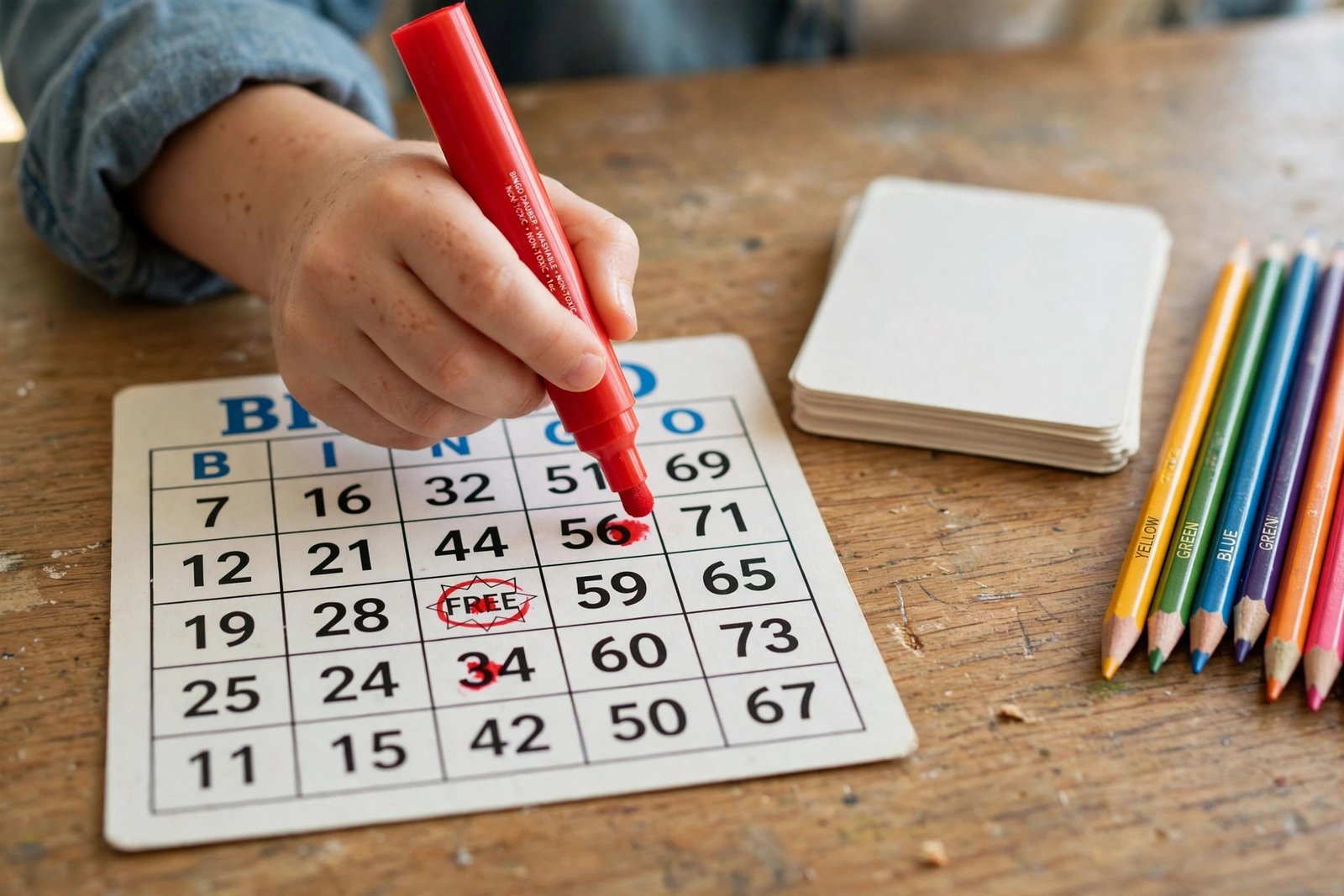
Draw a five-by-five grid and put one item in each square, leaving the centre square free. Then make a new card with the same items in a different order. Repeat until every student has a card. You do not need a different set of items for each card — the same twenty-four items in a different order is enough to make every card unique. If you are short on time, let students copy a blank grid and fill it in themselves from your list on the board. That takes two minutes and doubles as a writing activity.
Step 3: Run the game
Call out the items one at a time. For younger students, say the word clearly and show it on the board. For older students, give a clue or a definition instead of the word itself, so they have to think before they mark. The first student to finish a row, a column, or a diagonal calls out bingo. Check the winning card against your list, celebrate the win, and start a new round. Two or three short rounds usually fill a lesson better than one long game.

12 Bingo Game for Classroom Ideas for Every Subject
A bingo game for classroom never gets boring when the content keeps changing. Here are twelve ideas teachers use again and again, one for almost every subject and situation.
1. Vocabulary bingo. Put the week’s spelling or vocabulary words on the cards and call out the definitions. Students have to match meaning to word, which is much stronger revision than copying a list.
2. Maths facts bingo. Use multiplication or addition answers on the cards and call out the sums. A card with 12, 18, and 24 on it turns times tables into a race.
3. Sight words bingo. For younger readers, fill the cards with the sight words they need to recognise instantly. Fast recognition is exactly what sight word practice is for.
4. Science terms bingo. Put key terms from the chapter on the cards and call out simple descriptions. Students connect the term to what it means instead of memorising it in isolation.
5. History dates bingo. Put years on the cards and call out the events. It turns a dry timeline into a game students actually remember.
6. Geography bingo. Use countries, capitals, or map features. Call out a clue such as the capital city, and students find the country.
7. Picture bingo. For the youngest students, use pictures instead of words: animals, colours, shapes, or objects. The teacher calls out the name and students find the picture.
8. Synonym and antonym bingo. Put a word on each square and call out its synonym or its opposite. It stretches vocabulary in a way a worksheet rarely does.
9. Fractions bingo. Put fractions on the cards and call out their decimal or percentage equivalents. Students practise converting without realising they are doing extra maths.
10. Foreign language bingo. For language classes, put the words in the language students are learning and call out the English meaning, or the other way round. It is simple, fast revision of new words.
11. End-of-week review bingo. Mix words and facts from everything the class covered that week. It is a gentle way to find out what stuck and what needs another look.
12. Icebreaker bingo. On the first day of term, put fun facts on the cards, such as “has a pet dog” or “can whistle”. Students have to find classmates who match each square. It works as a get-to-know-you game and a first bingo at the same time.
How to Play a Bingo Game for Classroom on Baamboozle
Paper cards are lovely, but a digital game saves time and adds excitement. Baamboozle is a classroom game platform where the teacher opens a game on one shared screen and the whole class plays together. No student needs a device or a login, which makes it easy to run in any classroom.
To play bingo on Baamboozle, open the official Baamboozle website and search for a bingo game that matches your topic, or build your own with your list of words and questions. The class picks a tile, answers the question, and earns points for the team. Because the game runs on the big screen, every student can see the board, and the teacher controls the pace. Ready-made games are a good place to start: the Baamboozle science games collection, for example, already has tiles and questions prepared, so you can open it and play in under a minute.
The best part of the digital version is the surprise. Baamboozle games include special tiles that can swap scores, steal points, or double a team’s total. Those moments keep the class laughing and watching the board, even during a revision lesson. The game still teaches the same words and facts as the paper version, but the energy in the room is completely different.
Tips to Make Your Bingo Game Even Better
A few small habits turn a good game into a great one. First, keep the rounds short. Three quick rounds with fresh cards beat one slow round where half the class has already finished. Second, let students be the caller. A student caller practises reading the clues aloud, and the class listens more carefully to a classmate than to the teacher. Third, vary the winning pattern. One round can be a full row, the next can be four corners, and the next can be a full card. Different patterns keep the game from becoming predictable.
Fourth, mix easy and hard calls. If every call is easy, the game ends too fast. If every call is hard, students give up. A mix keeps everyone in the game until the end. Finally, keep a small prize box. The prize does not need to be big: a sticker, a pencil, or the right to choose the next game is enough. The prize is not the point. The point is that every student played, practised, and enjoyed the lesson.
Common Mistakes to Avoid
The most common mistake is making the cards too hard. If students cannot read the words or do not know the facts yet, the game becomes a guessing contest instead of revision. Use content the class has already met at least once. Another mistake is playing for too long. Bingo is a warm-up and a review tool, not a whole lesson by itself. Fifteen to twenty minutes is usually the sweet spot.
A third mistake is letting one loud student dominate the calling or the checking. Rotate the caller, check the winning card every time, and keep the rules the same for everyone. Fairness is what makes students want to play again tomorrow.
Frequently Asked Questions
How long does a classroom bingo game take?
A single round usually takes five to ten minutes, depending on the size of the cards and the age of the students. Most teachers play two or three rounds in a fifteen to twenty minute slot.
Can I play bingo with a large class?
Yes. Bingo works well with large classes because every student has a card and plays at the same time. For very large groups, use a digital game on the shared screen so everyone can follow the board.
What age group is bingo best for?
Bingo works from the youngest students, who play with pictures, up to older students, who play with vocabulary, dates, and subject terms. The game stays the same. Only the content changes.
Do I need to print cards for every lesson?
No. You can reuse a set of printed cards for a few weeks, or you can play digitally and skip printing altogether. Many teachers keep one printed set for each topic and reuse it through the term.
Is bingo only for revision?
No. Bingo also works for introducing new words, for warming up at the start of a lesson, and for celebrating the end of a topic. Any time students need to recognise and recall items quickly, bingo can help.
A bingo game for classroom is one of those rare teaching tools that is simple, cheap, and genuinely effective. It needs no training, no budget, and no special equipment, and it turns revision into something students ask for instead of something they endure. Pick a topic, make a set of cards, and try one round this week. The chances are good that your students will ask to play it again tomorrow.